
Match play scores golf by holes won, not total strokes. You and your opponent are playing a separate contest on every hole. Take fewer strokes and you win the hole. Win more holes than they do and you win the match.
That sounds like a small change. It is not. A triple bogey that ruins a stroke play scorecard only loses one hole in match play. You can walk to the next tee, reset, and be right back in it.
It is the format behind the Ryder Cup, but it also gives an ordinary Saturday game with a friend a different feel. Once you understand the score, the next question gets more interesting: what does the match need from you on this hole?
How does match play scoring work?
The score tracks holes, not your total shots for the round. Under R&A Rule 3, match play is decided by holes won, lost, or tied. The match ends once one side leads by more holes than remain.
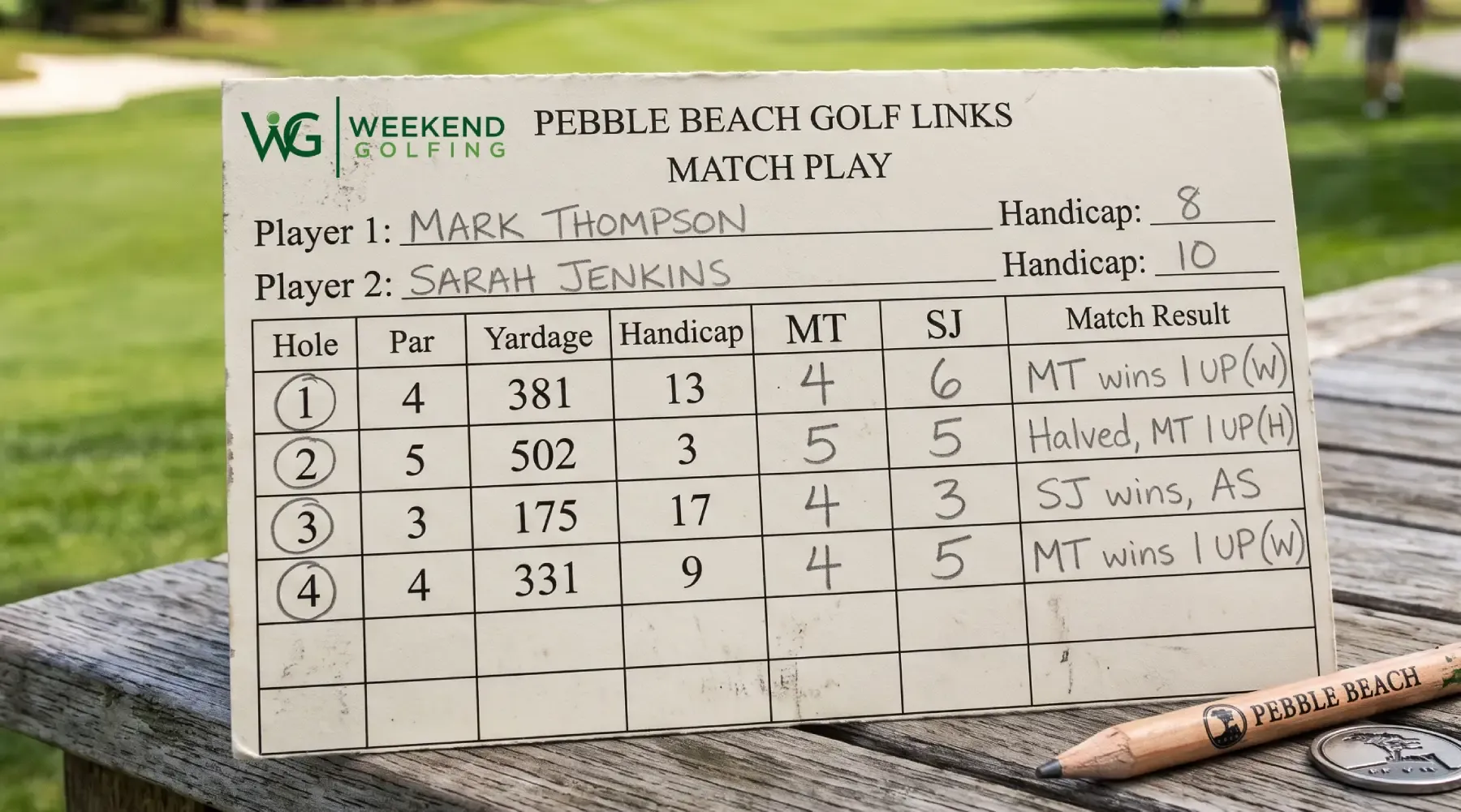
That is what it looks like on the card. The stroke scores still go in the middle columns, but the column that decides anything is the one on the right, where each hole is settled and the running match score gets carried to the next row.
You will hear three score calls all day:
- 2 up: you have won two more holes than your opponent.
- 1 down: your opponent has won one more hole than you.
- All square: you have won the same number of holes.
A hole is won by the lower score. If you both make the same score, the hole is halved and the match score stays where it was.
| Hole | Your score | Opponent's score | Match score |
|---|---|---|---|
| 1 | 5 | 6 | You are 1 up |
| 2 | 4 | 4 | You stay 1 up |
| 3 | 7 | 5 | All square |
| 4 | 4 | 5 | You are 1 up |
That is the bit that can feel strange at first. You made a 7 on the third hole, but it only cost one hole. It did not carry a two-shot disaster into the rest of the match.
What does 3&2 mean?
A result of 3&2 means the winner was 3 up with 2 holes still to play. The match was over because the other player could not win enough remaining holes to catch up.
A result of 1 up means the match went all the way to the 18th and finished with a one-hole margin. There is no second number because there were no holes left.
What does dormie mean?
You are dormie when you lead by the same number of holes as there are holes left to play. For example, you are dormie at 2 up with 2 to play.
You cannot lose the match in regulation from there. Halve one of the remaining holes and you have at least tied the match. By default, R&A Rule 3 then extends a tied match one hole at a time until somebody wins, but the terms of the competition can say it stands as a tie instead. Worth knowing which one you are playing before you get there.
A few other terms worth knowing:
- Halved: both sides make the same score on a hole.
- Concession: you give your opponent their next stroke, the hole, or the match. It needs to be clearly communicated and cannot be taken back.
Match play vs. stroke play
In stroke play, every shot follows you around the course. In match play, the damage is contained to the hole you are on.
| In stroke play | In match play |
|---|---|
| Lowest total number of strokes wins. | Most holes won wins. |
| A triple bogey hurts your total score. | A triple bogey loses one hole. |
| You normally hole every putt. | A next stroke, hole, or match can be conceded. |
| You mostly play the course and your number. | Your opponent's position can change the decision. |
That last point is where match play gets fun. If your opponent is already in the trees, you may not need to take on the tucked pin. If they have knocked it close, playing safely to 40 feet might not be enough.
Before the first tee, settle this stuff
A friendly match can get awkward quickly when the group only works out the details halfway down the first fairway.
Before you start, agree on:
- the format
- each player’s handicap
- where handicap strokes apply
- whether a tied match continues or finishes tied
- how strictly you are playing the rules
In a handicap match, R&A Rule 3.2c says you and your opponent should tell each other your handicaps before you start. If you are not sure what yours is, this is how a handicap index actually works. The lower net score wins each hole, and you both need to know where handicap strokes apply from the scorecard’s stroke-index allocation.
Common match play formats
Singles
Singles is classic one-on-one golf. Both players play their own ball and the lower score wins the hole. It is the format you see on the final day of the Ryder Cup, Solheim Cup, and Presidents Cup.
Four-ball
Four-ball, covered by R&A Rule 23, is two against two. All four golfers play their own ball, but only the lower score from each side counts on a hole. If you make 5 and your partner makes 4, the side has made 4.
It is a good fit when a group wants the team element but still wants everyone playing their own ball.
Foursomes, also called alternate shot
Foursomes, covered by R&A Rule 22, is also two against two, but each side shares one ball. One player tees off on odd-numbered holes, the other on even-numbered holes, and the partners alternate every shot until the ball is holed.
That is true team golf. It also makes you care a lot about the lie you leave your partner.
Play the situation, not your ego
Match play is not a license to hit every hero shot. It is a reason to stop winging the decision.
Before a risky shot, check three things: the match score, how many holes remain, and whether your opponent is already in trouble. That is the same smarter decision-making on the course that lowers your score in any format.
Early in the match or all square
Play your normal percentages. You do not need to force a birdie on the second hole just because it is match play. Hit the shot you would normally choose and make the other player earn the hole.
When you are ahead
Make the opponent beat you. Fairway and green can be enough when they have already put themselves in trouble. You do not need to answer their bad shot with your own ambitious one.
When you are behind late
At some point, playing safe is the same as losing slowly. Pick the hole where you need to create an advantage, then choose the aggressive line because the match calls for it, not because you are annoyed.
You are not trying to shoot a number. You are trying to make the best decision for the hole in front of you.
The bottom line
Match play is golf scored one hole at a time. Learn the basic score calls, agree on the format and rules before you start, then let the match situation guide when you play safe and when you attack.
The next time somebody suggests a match, do not just say yes and hope the scoring works itself out. Set it up properly, then enjoy the fact that one ugly hole does not have to wreck the whole day.