
You shoot around 100 most weekends and someone asks your handicap. What do you say?
You could say 28. On a standard course, that’s a reasonable ballpark.
But it is not your official Handicap Index. Not yet.
The quick answer
If the course has a 72.0 Course Rating and 113 Slope Rating, the rough score differential is your score minus 72.
| If you shoot | Rough single-round differential |
|---|---|
| 110 | 38 |
| 105 | 33 |
| 100 | 28 |
| 95 | 23 |
| 90 | 18 |
| 85 | 13 |
| 80 | 8 |
This table is a quick estimate only. It assumes your adjusted score is the same as the number on your card and that you played a standard-rated course.
That is why shooting 100 does not automatically mean you are a 28-handicap golfer. It means that one round worked out at roughly a 28 differential under those assumptions.
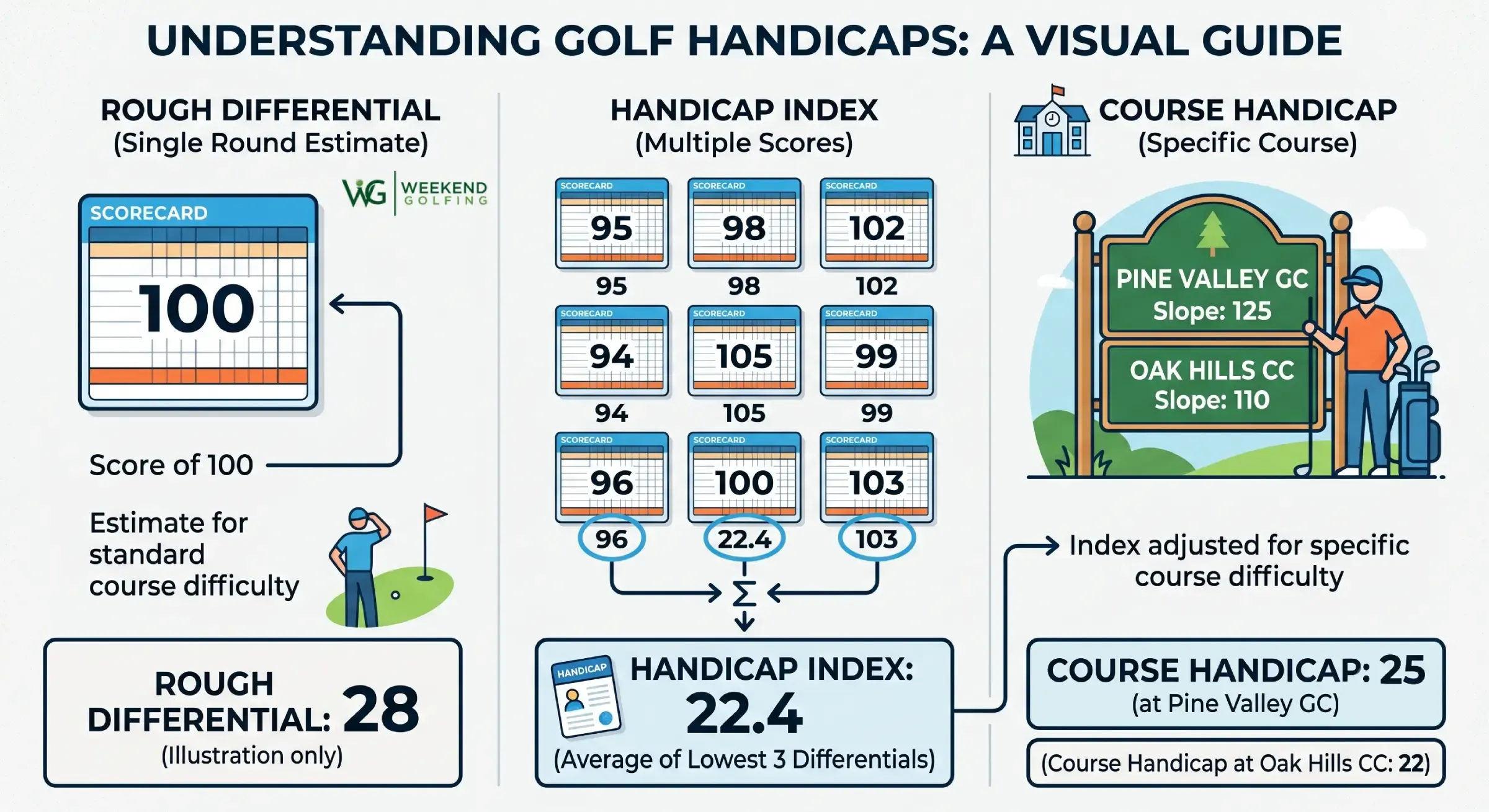
Why one score is not your official handicap
Golf’s handicap system does not take your last score, put a label on it, and call it done.
It uses score differentials. Once you have recorded scores for 20 rounds (or more), your Handicap Index is based on the lowest eight. With fewer scores, there is a separate process rather than a made-up shortcut. The official details sit in the Rules of Handicapping. If the vocabulary is the confusing part, the golf glossary covers these terms in plain English.
That does two important things.
First, it accounts for the course. An 89 from a tough set of tees is not the same as an 89 from a short, easy course.
Second, it stops one brilliant day or one ugly day from becoming your identity as a golfer.
I needed that reminder myself. My Handicap Index was 20.4 in early 2025. A good round could make me think I had finally cracked it. A bad one could make me think I was going backward. Neither reaction told me much on its own.
The number gave me a better view of where I was. But it did not tell me why I was there. For that, I had to look at where I was losing shots.
The three numbers people mix up
Most handicap confusion comes from using one word for three different things.
1. Your score
This is the number you wrote down after the round. Maybe it was 100. Maybe it was 90. It is one piece of the picture, not the whole thing.
If it was a casual round with mulligans, conceded putts, or a few generous drops, it might not even have been an accurate reflection of how you really played.
2. Your Handicap Index
A Handicap Index is built from acceptable scores and the course information attached to them. It gives a fair picture of what you are capable of on a good day, not your average score every time you tee it up.
Once you have 20 scores, it uses the average of your eight best score differentials. Think of those eight as your better rounds. If roughly four sit below your Index and four sit above it, that leaves about four rounds out of 20 where you play better than your handicap. That is roughly one round in five.
It is a simple way to understand the math, not a promise about your next five rounds.
The rules behind your handicap index include score adjustment, acceptable-score rules, and a calculation that updates as more scores go in. That is why the rough table above is a ballpark, not the final word.
3. Your Course Handicap
Your Course Handicap is the number of strokes you get at the course and tees you are playing on any given day.
Your Handicap Index travels with you. Your Course Handicap changes with the course and the tees.
So if you already know your Index, do not try to reverse-engineer it from your last score. Course and slope information will tell you how that Index applies where you are playing.
What to do next
Pick the one that sounds like you.
I only have one recent score
Use the table as a ballpark. Write down the Course Rating and Slope from the tees you played, but do not turn one score into a more precise number than it deserves.
I have three or more recent scores
The golf handicap calculator can help you work through the course details. If you want an official Index, start posting acceptable scores through your club or handicap provider.
The exact setup depends on where you play, so use your national association or club as the final authority.
I already know my Handicap Index
Use it for what it is good at. Work out your Course Handicap before a round with the slope rating calculator, make games with your mates fairer, and track whether your scoring level is moving over time.
Then ask the better question: where are the shots going?
Your handicap tells you where you are, not what to fix
A handicap can tell you whether the overall picture is improving. It cannot tell you whether the main problem is approach shots, penalties, three-putts, or the bad decisions that turn one mistake into a double. Nor will your memory of the round fill that gap, because it quietly edits itself on the drive home.
That was the gap for me. I went from a low-20s handicap to breaking 80 for the first time in under a year. Tracking my handicap mattered. But the improvement came from getting more specific about the shots behind it, not from staring at the number harder.
If you have three or more recent scores, use the golf handicap calculator. It is free and it does not need your email.