
Golf wedge degrees are the lofts on the club. A pitching wedge is usually the lowest-lofted wedge, then come the gap or approach wedge, sand wedge, and lob wedge. The useful question is not which label you need. It is whether the lofts and carry distances in your bag leave you with a shot you do not trust.
Start with the actual loft of your pitching wedge. Then look at the wedges below it. A 4 to 6 degree gap is a sensible place to start, but it is not a fitting prescription. Your real carry numbers decide whether the setup works.
| Wedge | Common loft range | What it is usually for |
|---|---|---|
| Pitching wedge | 44 to 49 degrees | Longer wedge approaches and lower-running chips |
| Gap or approach wedge | 48 to 52 degrees | Filling the space between the pitching wedge and sand wedge |
| Sand wedge | 54 to 58 degrees | Full and partial wedge shots, bunkers, and short-game shots |
| Lob wedge | 58 degrees and higher | Higher shots when you need them |
Start with your pitching wedge
Modern iron sets have stronger lofts than they used to. Hireko’s wedge fitting guide tracks a standard pitching wedge moving from 49 degrees in the 1970s to 45 degrees, and 44 degrees from 2017 onward. Nothing wrong with that. It just means a standard 52 and 56 degree pair might not make much sense after your pitching wedge.
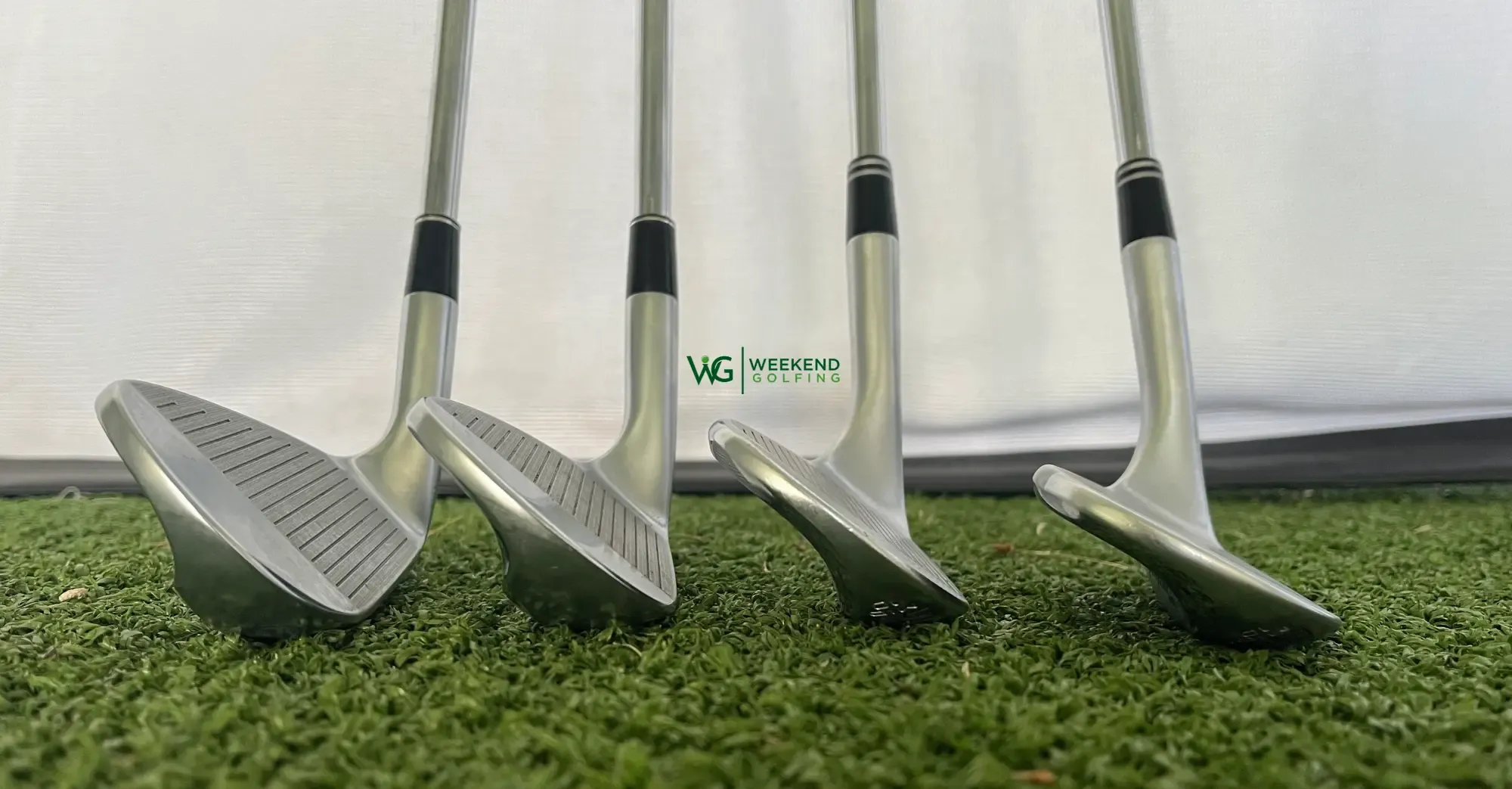
My own iron set has a 44-degree pitching wedge and a 50-degree approach wedge. From there, I go to a 54-degree Cleveland RTZ with 10 degrees of bounce, then a 60-degree Cleveland RTZ.
That works for me. It is not a setup I expect you to copy. It gives me a clear place to start when I check my carry numbers and pick the shot I want to hit.
Those ranges overlap because the letters on a club are not standard. Hireko lists the same club as a GW, AW, DW, or UW depending on who built it, and Vokey says outright that there is no standard gap wedge loft. A 48-degree wedge can be the set gap wedge in one bag and a specialty wedge in another. That is why the loft matters more than the name. Treat this chart as a starting point, not a shopping list.
This is where the trouble usually starts. A 44-degree pitching wedge and a 50-degree next wedge look fine written down. But if you have never measured the carry gap between them, the shot from the middle of that gap is a guess every time you face it. The problem is not the letter stamped on the club. It is a gap you have not measured or learned to cover.
How to gap your wedges
A four to six degree gap is a decent place to start. Vokey recommends the same 4 to 6 degrees between each wedge, while still pointing you at a wedge fitter if you want to get more precise than that.
But do not get too attached to a tidy sequence of numbers.
A 44, 48, 52, 56, 60 setup looks great on paper. It might work. It might not. Different shafts, strike quality, how you deliver the club, and the ball you play can all change the carry gap.
No need to turn this into a maths project. Do three things:
- Find the loft stamped on every wedge.
- Hit enough stock shots to get a carry number you trust, and write them into a personalised club distance chart.
- Notice the distance where you start trying to manufacture a swing instead of just picking a club.
That last one is usually where the problem is hiding. You do not need every wedge to be exactly 10 yards apart. You need to know what you are going to hit when you have 125 yards to a front pin, wind in your face, and water short.
Here’s my actual wedge gapping from Tangent App based on real shots on the course.
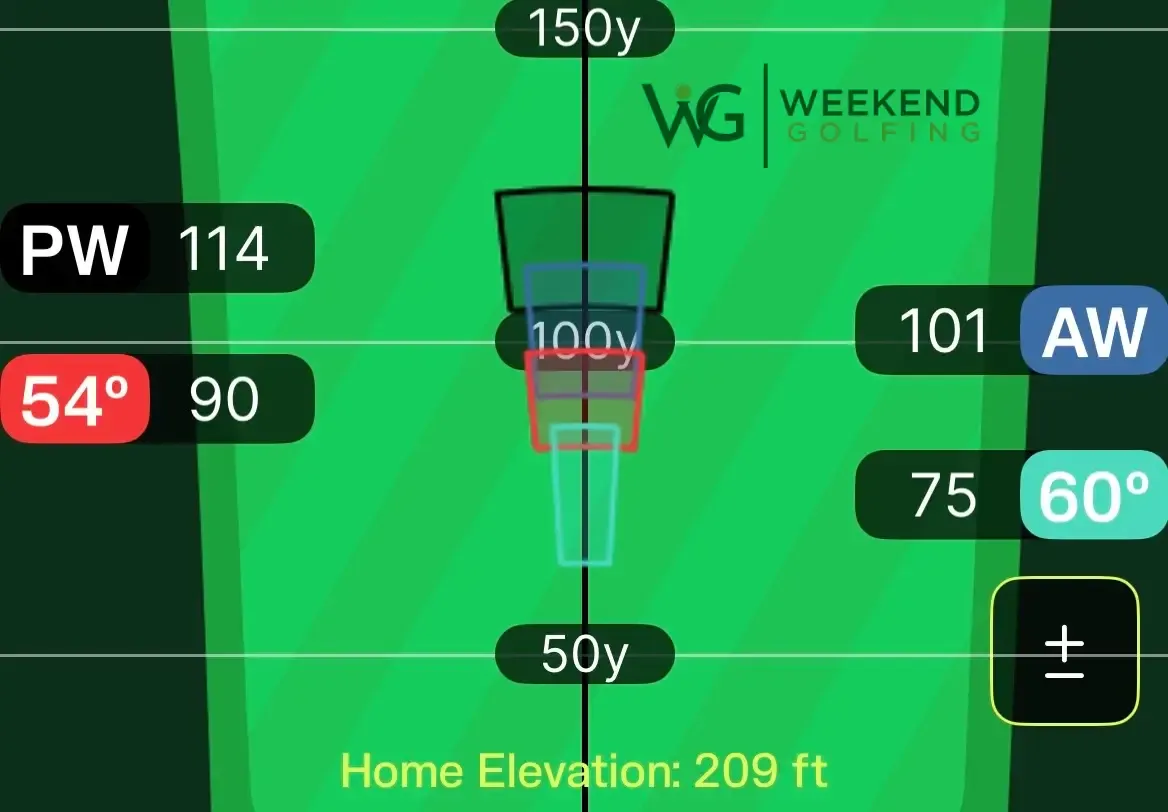
Pitching wedge 114, approach wedge 101, 54 degree 90, 60 degree 75. That is a 13 yard gap, then 11, then 15. Not tidy, and not 10 yards apart. What makes it useful is that those are carries I have actually hit on the course rather than numbers I assumed, so I know the 60 covers 75 and the wider gap sits at the bottom of the bag where I have more shot options anyway.
Check your wedge gaps
Start with the clubs already in the bag. Put them in loft order, add your stock carry numbers if you have them, and find the gap that is much bigger or smaller than the rest.
Wedge-gapping check
Put in the loft stamped on each wedge you already carry. Add your stock carry numbers if you have them. Stock carry means your normal carry, not total distance, a chip, or a max swing. Only the pitching wedge is required.
Your lofts in order
This is a gap check, not a fitting. Strike, swing delivery, shaft, ball, turf, and the shots you play still matter.
That gives you something useful to test at the range or with a fitter.
What bounce means on a wedge
Bounce is the part of the sole that stops the club from digging too much. That is the simple version.
The number matters, but it is not the whole story. The sole shape, your angle of attack, the turf, the sand, and the shot you are trying to hit all matter as well.
As a rough starting point, lower bounce tends to suit firmer turf and tighter lies. Mid bounce is a useful middle ground. Higher bounce can help in softer turf and softer sand because the sole is more likely to glide instead of digging. Vokey draws the low bounce line at 4 to 6 degrees and calls anything above 10 degrees high bounce, aimed at soft turf, fluffy lies, and soft sand.
My 54 has 10 degrees of bounce. Around the green, I use my pitching wedge when a bump and run is there. If I need to chip, I nearly always grab the 54. In bunkers, I like having the 60 there for the extra loft.
Whichever wedge you reach for, the grooves have to be clean or you will not get the spin the loft is supposed to give you. Cleaning your clubs properly does not take long and is the cheapest performance in the bag.
That is just how I use them. It does not prove a 54 with 10 degrees of bounce or a 60 is right for you. The bounce number is the easy part to read off the club. The harder part, and the one worth working out, is what job each wedge is actually doing in your bag.
Do you need a lob wedge?
Not just because everyone else seems to carry one.
A lob wedge gives you more loft when you need to get the ball up quickly or land it with less run. It also asks more of your strike. If a bump and run is on, it is usually the simpler play. If the 60 fills a measured gap or gives you a shot you use a lot, that is a better reason to carry one than wanting a complete-looking set.
The question is rarely whether three wedges beat two. It is whether a third wedge fits the lofts already in your bag and the shots you actually play. Work that out from your own carry numbers before you spend anything.
Build a wedge matrix from your own numbers
One of the things I take you through in DIAL is building your own wedge matrix. It maps your wedge distances and swing efforts with the clubs you already have. No generic chart. No trying to remember one good shot you hit on the range three weeks ago.
The point is not to build a spreadsheet because spreadsheets are fun. It is to know your stock carries and a few reliable shorter swings, so the club choice is easier when it matters.
You do not need a launch monitor to start. Pick a calm day at the range or a quiet bit of the course. Hit the shots you use most. Record carry, not rollout. Then keep updating it as you learn something.
Before you buy another wedge, check the lofts, test the carries, and find the actual gap. That is a much better place to start than buying clubs based on the letters stamped on them.