
You do not need a chart that tells you what a seven iron should do.
You need something you can look at when the pin is 142 yards away and you cannot remember whether that is a comfortable seven or a hard six.
That is why generic golf club distance charts are only a starting point. They can give you a rough sense of the bag. They cannot tell you what your clubs do on a normal swing, on your course, with your strike.
The useful chart is the one you build from your own carry numbers.
Start with carry, not your best shot
Carry is how far the ball travels through the air before it lands. It is different from total distance, which includes what happens after the ball hits the ground. Trackman defines carry the same way, and makes the point that it is your average carry worth knowing, not your longest.
This matters because a soft fairway, firm fairway, downhill landing area, or sloping landing area can change rollout. Your carry number gives you a better starting point when you need to clear trouble or carry the ball onto a green.
Do not write down the one flushed shot that made you laugh at the range. Use the normal shot you would be happy to see on the course.
A quick way to get usable numbers
If you are not tracking every shot on the course (you should be), a launch monitor makes this quicker. But you don’t need one if you don’t have access.
Pick a calm day. Use the range markers you trust, or a quiet stretch of course where you can see where the ball lands. Hit normal shots with the clubs you actually use. Write down the carry you keep seeing, not your best shots. Wipe the faces before you start, because dirt in the grooves changes spin and control, and a quick club clean keeps you from recording numbers you cannot repeat.
If the number keeps moving around, that is useful too. Do not force a false answer onto the card. Leave a note like “not reliable yet” or “good strike only”, or write a range from the smaller number to the bigger one. Then come back to it after a few more sessions.
The goal is not a perfect chart. It is fewer guesses on the course and something you can start putting into practice.
Neat ten-yard gaps are not the goal either. Real bags rarely work that way. What matters is knowing where the gaps are and whether a club gives you a shot you trust.
My own bag is a good example. I use Tangent to track every shot I play on the course. Here is a snapshot from my app:
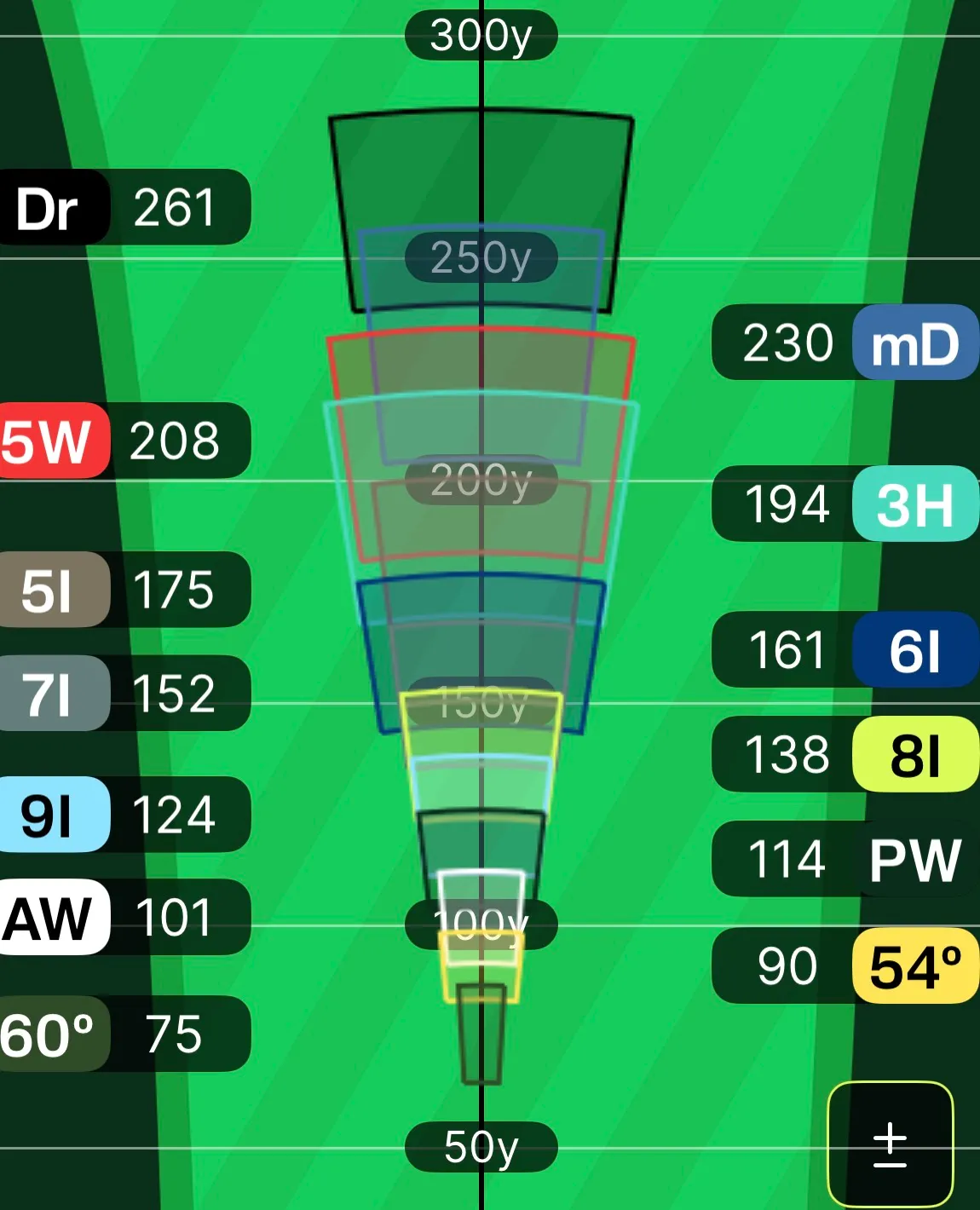
Build your own printable distance chart
Pick the unit you use on the course. If your watch, rangefinder, and scorecard are in yards, use yards. If you play in meters, use meters. You do not need to convert everything back and forth to make the card useful.
Then add the clubs you carry and the stock carry you trust for each one. A stock carry is your normal full shot, not a max swing, a chip, or a total-distance guess.
Your personal carry card
Pick the unit you use on the course, then add the clubs you carry and the stock carry you trust for each one. Nothing here is worked out for you, saved, or sent anywhere. It is your card, and it prints as you typed it.
Nothing you type is stored, sent, or added up anywhere else. Print the card, then change it when you learn something on the course.
Add your Wedge Matrix
Full-swing numbers are only part of the card.
Inside 100 yards (or 100 meters), you often have more than one way to play the shot. That is where it helps to write down the club, your own swing-effort cue, and the carry you have practiced.
Your cue might be “smooth 54”, “chest-high 50”, or whatever language makes sense to you. It does not need to match somebody else’s idea of a half or three-quarter swing. Those labels mean different things in different hands.
Under 100 yd
Write down the club, your own cue for the swing, and the carry you have actually practiced. The cue is yours. It does not need to match anybody else's idea of a half or three-quarter swing. This prints on the same card as your stock carry numbers.
Your cue is never turned into a percentage or a predicted distance. It prints exactly as you wrote it, next to the carry you trust.
This is part of what I cover in the DIAL Method. You build a wedge matrix around the shots you can repeat, then use it when the distance gets awkward instead of trying to manufacture something at the last second. If the awkward distances trace back to the lofts of the wedges you carry, that is worth sorting out before you practice around it.
What to do with the gaps
Once the card is filled in, look for the places that make club choice awkward.
Maybe two clubs carry almost the same distance. Maybe there is a large jump from your longest iron to your next hybrid. Maybe your wedges are fine on full shots, but you have nothing you trust for the distance between a stock gap wedge and a stock sand wedge.
This is useful information for the course. It gives you opportunities to investigate. First check that your numbers are correct. Hit the clubs again. Notice whether the issue is carry, strike, launch, or simply a club you do not like hitting.
Once you have filled in your card with what you have now, it tells you what is worth testing instead of guessing.
What an average chart can and cannot do
There is nothing wrong with being curious about average distance. It gives you a reference point. Just do not turn it into a verdict on your swing or your handicap.
A generic number does not know your lofts, shaft, strike, ball, course, or what happens when you are trying to carry a bunker with a scorecard in your pocket.
Use an average chart to get curious. Use your own carry card to choose a club.
Print it, then change it when you learn something
Keep the card in your bag, on your phone, or in the notes you use before a round. Update it when you learn something real.
That might be a new club. It might be a better contact pattern. It might be finding out that your “easy” wedge shot goes farther than you thought.
Build the card first. Then use it for a few rounds before you decide the bag needs fixing.
Go back to the carry card and print yours.
And if you want some help to hit the ball more consistently, check out the DIAL Method.