
A golf shaft flex chart can give you somewhere to start but it won’t tell you what shaft is best for you.
If you are trying to choose between regular, stiff, or an extra stiff shaft, use your swing speed to make a shortlist. But then hit some balls with each shaft. Pay attention to how they feel, what the ball does, and whether you can get consistent results. This is what a golf shaft flex chart cannot do for you.
The letter on the shaft matters, but it’s not the full answer.
Start with swing speed, but don’t treat it like a verdict
Most flex charts put driver swing speed into rough starting groups like these:
| Driver swing speed | Starting point to test |
|---|---|
| Under 72 mph | Ladies or senior flex |
| 72 to 83 mph | Senior flex |
| 84 to 96 mph | Regular flex |
| 97 to 104 mph | Stiff flex |
| 105 mph and above | Extra-stiff flex |
Those ranges are common in fitting guides, including MyGolfSpy’s driver shaft flex chart. They are useful if you don’t know where to begin. They are not a rule that tells you which shaft will work best for you.
A 100 mph driver swing might put one golfer in stiff and another in extra stiff. A smooth swing and a fast, aggressive transition can react differently to the same shaft. The same goes for driver and irons. Do not assume the flex in one club should automatically follow the rest of your bag.
So use the chart only as a starting point to narrow down your choices.
Why the letter does not tell the whole story
Shaft flex letter designations (R, S, X etc.) are meaningless because there is no standardization between manufacturers. One company’s “stiff” might be another’s “regular” or even “senior flex”.
Titleist makes the point well: no single shaft specification defines performance, and test methods vary by manufacturer. Weight, torque, and how stiffness is distributed through the shaft can all change how a club feels and performs.
Adding to the confusion, even within one manufacturer’s stiff range they now produce versions to help achieve higher launch and spin, lower launch and spin, and everything in between. So stiffness is even less relevant.
The image below shows spin and launch profiles for different shafts. Every one of these is rated “Stiff”.
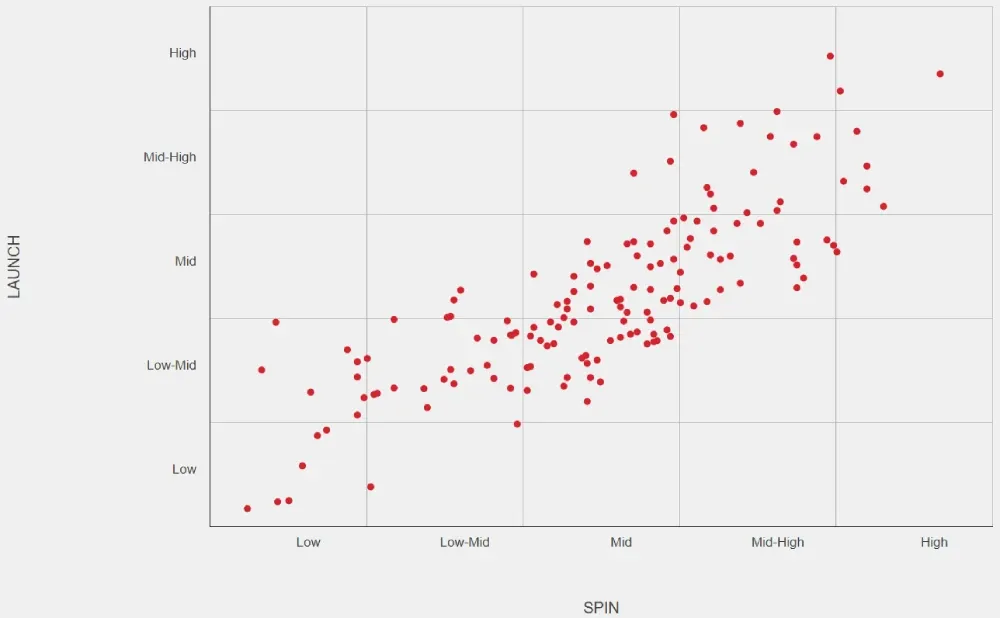
That is why two shafts marked “stiff” can feel completely different. One may feel hard to load. Another may feel lively through impact. Neither label tells you enough on its own.
The best golf shaft for you is 100% individual and unfortunately there is no guide or rules (including swing speed) on what will definitely give you the best results.
The only way to know is to test out different shafts for yourself and see what feels best and what gives you the results you are looking for.
What I saw during my fitting
I did my first club fitting in July 2025. The first session was irons. The second was driver.
For the iron fitting, I warmed up, hit my current 6-iron for a baseline, then worked through heads and shafts. The fitter didn’t tell me what had changed when he handed me a different shaft. He just asked how it felt, then we looked at the launch-monitor results.
A few options felt way off straight away. Others were close. In the end, I chose the option that felt best and worked best for me.
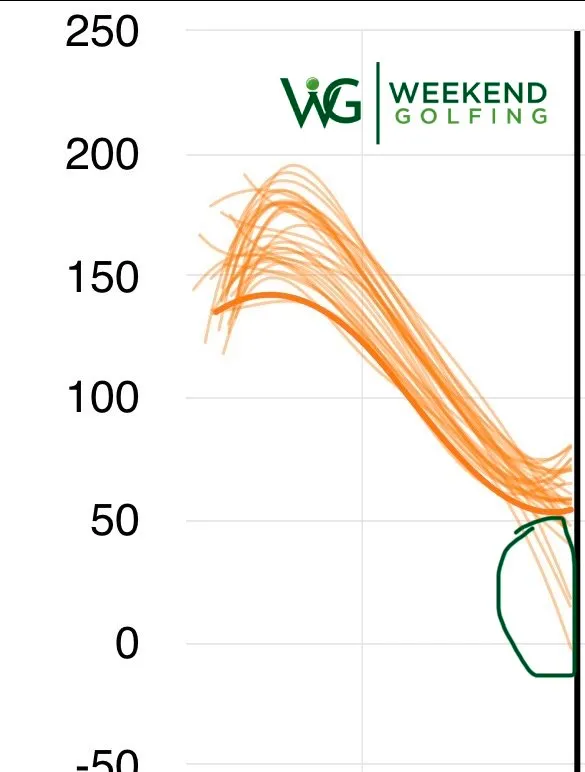
The fitter also showed me speed-profile graphs through the swing. One of the main things he was looking for was consistency, especially through impact. Some of the shafts I was testing created bigger jumps and more variance, while others suited the way I loaded the club better.
The image below shows an example of this. It’s a plot of acceleration (in Gs) heading into impact. The swings circled in green are what we want to avoid.
The driver session followed a similar process, but the shaft came first. We established a baseline with my own driver, tried a lot of shafts, then tested heads once we had found a shaft that felt right.
That changed how I think about flex. The right shaft mattered more to my results than I expected. But that does not mean you need to replace your clubs because a chart made you nervous. Off-the-shelf or second-hand clubs are fine when you are getting started. That’s what I used for many years. When you are ready to spend proper money on a new set, a fitting gives you the best way to find the optimum solution for you.
What the research says, without turning it into a magic rule
Research doesn’t support treating one flex label as a perfect match for one swing speed.
In a 2016 study, MacKenzie and Boucher had 33 golfers test drivers with two different shaft stiffnesses. Across the full group, there was no significant clubhead-speed difference. Individual responses still varied, though, which is the important bit if you are the person holding the club.
Burger and Senner tested 20 golfers and found that clubhead speed alone was not enough to decide an individual shaft fit. The players compared different combinations of shaft weight and flexibility, and their ratings of shot quality and feel mattered too.
That does not mean flex is irrelevant. It means the useful question is not “What flex should someone with my speed use?” It is “Which shafts should I test, and what happens when I do?”
Testing golf shafts
Putting it all together, if you want to find the best golf shaft and flex for you there are 2 ways:
1: Find a higher quality club fitter near you and let them help you. They should have a bunch of shafts you can try and test and will be able to help you interpret the data and result.
You will need to pay the fitter a fee, but it means you don’t have to fork out any cash for a bunch of shafts.
2: If you are not ready for a full fitting yet, you can also test it yourself.
Start by deciding what you are trying to improve. Why are you looking at changing clubs or shaft?
- Maybe you want a more controllable flight?
- Maybe you want to see if a club that feels too stiff is costing you confidence?
- Maybe you are just trying to avoid buying the wrong thing?
Then get some shafts and test yourself.
This will mean you need to buy some shafts up front. But once you have figured out which one you want to keep, you can sell the rest in almost brand-new condition and get back most of your money.
The most popular brands by tour players are below (links to Amazon):
- True Temper (30%)
- Project X (woods), Dynamic Gold (irons)
- Mitsubishi (21%)
- Diamana (woods), Tensei (woods and hybrids), MMT (irons)
- Fujikura (18%)
- Ventus (woods), Speeder (woods)
- Graphite Design (8%)
- Tour AD (woods and hybrids)
Another option with a lot of shafts is 2nd Swing Golf.
Once you have a few shafts, here’s how to compare them properly:
- Keep the club head and loft the same where you can.
- Warm up before you start judging anything.
- For each shaft, keep at least five shots you would count in a normal comparison.
- Write down obvious mis-hits separately. Do not delete every bad swing until the numbers look nice.
- Record what you felt and what you saw: start direction, flight, carry, dispersion, strike quality, and whether you would trust that club on the course.
- If you have a launch monitor, compare the same settings, the same conditions, and the same golf ball.
Five shots is a prompt to compare properly, not a statistical test. It will not prove anything on its own and it is not a pass or fail threshold. It is just enough to stop you deciding from one good swing.
Copy this into your notes before you test:
| What I am comparing | Shaft A | Shaft B | What I noticed |
|---|---|---|---|
| Head and loft | Keep these the same if possible | ||
| Shaft model, weight, and label | |||
| Feel through the swing | |||
| Start direction and ball flight | |||
| Carry and dispersion | Same ball and monitor settings if available | ||
| Strike quality | |||
| Would I trust it on the course? |
Use the shaft test card before you buy from a flex label.
Once you have your favorite, keep it and then you can sell any shafts you no longer need.
That is the same approach that settles most gear arguments. It is how I worked out whether a 5-wood or a 3-hybrid belonged in my bag, and it beats anything a chart can tell you.
When a fitting is worth it
You do not need a fitting every time you buy a club. If you are new to golf, working with a tight budget, or still learning to make consistent contact, a decent off-the-shelf or second-hand option can be the sensible choice.
A fitting becomes more useful when you are about to spend serious money, replacing clubs you already hit badly, or stuck between options that all look right on paper. It gives you a way to compare the same decision with better information.
You are not paying someone to tell you whether you are a regular or stiff golfer. You are paying for the chance to test the whole thing without buying three wrong shafts first.
The bottom line
A flex chart can help you find the first few shafts to try. It cannot tell you which one will suit your swing.
If you are buying off the rack, use the chart as a starting point. If you are getting fitted, arrive with a clear idea of what you want to test. Either way, trust a repeatable comparison more than the letter printed near the grip.